
RSS

Royal LePage’s 2023 Market Survey Forecast

2023 national aggregate home price forecast to end year 1.0% below fourth quarter of 2022: Royal LePage

First quarter expected to show double-digit year-over-year declines, with modest quarterly price growth in the second half of next year

  • On a quarter-over-quarter basis, prices expected to flatten in Q2 and begin modest improvement in second half of the year, ending 2023 on upward trajectory; release includes national aggregate quarterly forecast for 2023
  • Condominium prices expected to outperform single-family homes in all major markets except Edmonton and Winnipeg
  • Greater regions of Toronto and Montreal forecast to see Q4 2023 aggregate price decline of 2.0% year-over-year
  • Q4 2023 aggregate home price in Greater Vancouver projected to dip 1.0% year-over-year
  • Despite declining affordability, heightened by rising interest rates, continued housing supply shortage acts as a floor on home price declines

TORONTO, December 13, 2022 – Since the Bank of Canada began raising interest rates aggressively in March of this year, home prices in many major markets across Canada have been decreasing. The rate of decline, however, has been modest. According to the Royal LePage Market Survey Forecast, the aggregate[1] price of a home in Canada is set to decrease 1.0 per cent year-over-year to $765,171 in the fourth quarter of 2023, with the median price of a single-family detached property and condominium projected to decrease 2.0 per cent and increase 1.0 per cent to $781,256 and $568,933, respectively.[2]

“After nearly two years of record price appreciation, fueled by a steep climb in household savings, very low borrowing costs and an overwhelming desire for more space during the COVID-19 pandemic, the frenzied housing market overshot and the inevitable downward slide or market correction began, intensified by rapidly rising borrowing rates,” said Phil Soper, president and CEO, Royal LePage. “In an era characterized by the unusual, this correction has not followed historical patterns. While the volume of homes trading hands has dropped steeply, home prices have held on, with relatively modest declines. We see this as a continuing trend.”

Soper continued, “Much focus has been directed at the negative impact of rising rates; there has been far less discussion on factors supporting home prices.”

The higher cost of borrowing erodes affordability, which historically has pushed people out of the market, reducing demand and resulting in falling home prices. Conversely, there are a number of factors supporting home prices in the current environment.

The supply of homes for sale must exceed demand in order for prices to drop materially. Canada is struggling with an acute, long-term housing supply shortage. Organic demand is supported by the current lifecycle of our large millennial demographic and a record number of new immigrants who need to be housed. Smaller household sizes mean more housing units are needed per capita than in the past. Pent-up demand is growing from buyers who have the ability to transact but have chosen not to in these turbulent times.

Low unemployment, and a large buffer of unfilled job vacancies, means that few families are likely to need to sell their homes for financial reasons. Homes are modestly cheaper today than at the height of the pandemic boom, offsetting some of the impact of rising rates, and household savings remain above long-term norms, making it easier to overcome down payment hurdles.

“Traditional wisdom says that a recession triggers widespread job losses and missed mortgage payments. People are forced to sell or the bank forecloses and lists the property, flooding the market with new listings when demand is weak. In this post-pandemic period, people have kept their jobs. In fact, they have seen wages and salaries rise,” said Soper. “We have a tightly managed national mortgage portfolio, with historically low default rates, supported by homeowners who have been required to qualify for a loan under the strict federal stress test for the last five years. And, we can’t forget that Canada has been grappling with an acute shortage of homes overall. We simply don’t see the factors at play that would result in a large drop in home values.”

While home prices nationally are forecast to see modest quarterly gains in the third and fourth quarters of 2023, values are expected to remain lower than the same periods in 2022 throughout the year. The aggregate price of a home in Canada is forecast to be 12.0 per cent lower in Q1 of 2023, compared to the same quarter in 2022, reflecting a 2.4 per cent decline over the fourth quarter of 2022. In the second quarter of next year, the national aggregate price is forecast to be 7.5 per cent lower year-over-year, and remain virtually flat on a quarterly basis. In the third quarter, homes are expected to be 2.0 per cent lower year-over-year, reflecting a 0.7 per cent increase on a quarterly basis. And, in the fourth quarter of 2023, the national aggregate price of a home is expected to end the year 1.0 per cent below the same quarter in 2022, an increase of 0.8 per cent quarter-over-quarter.
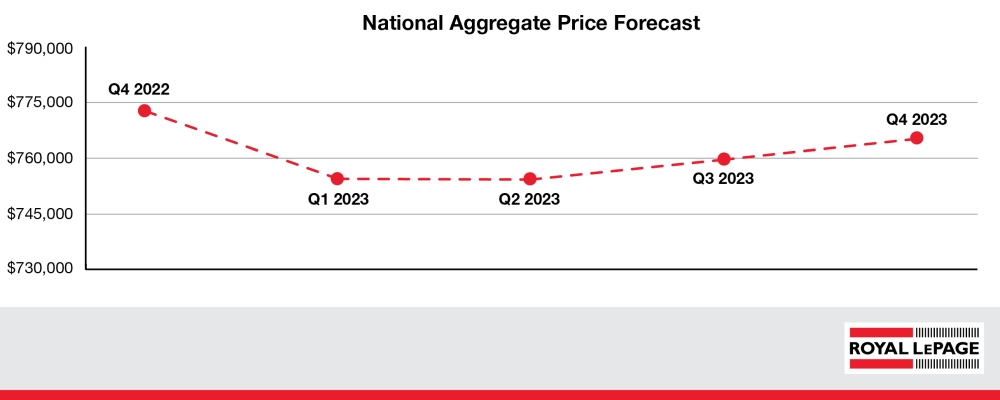
“Comparing prices to the previous year, the first quarter of 2023 should show the deepest decline in home values,” said Soper. “At that time, we will be comparing 2022’s final weeks of pandemic housing market excess – when home prices reached historically high levels – to a much quieter market, where values have had a full year to moderate. We expect year-over-year comparisons to show progressively less price decline as the year goes on, with small week-to-week improvements in the third and fourth quarters, allowing Canadian home values to end 2023 essentially flat to where we are today.”

The recovery is not expected to be evenly distributed. Regional markets that saw more moderate price growth during the pandemic real estate boom are expected to experience more modest declines. Due to their relative affordability, cities like Calgary, Edmonton and Halifax are expected to record modest price gains in 2023, as they continue to attract out-of-province buyers, especially first-time homebuyers from southern Ontario and British Columbia looking for more affordable housing.

While home prices have come down from the record highs recorded in the first half of this year, they remain well above pre-pandemic levels. The projected aggregate price of a home in Canada in the fourth quarter of 2023 is expected to sit 15.0 per cent above Q4 of 2020, and 18.4 per cent above Q4 of 2019.

Without a significant increase in housing supply, a return of buyers to the market, some driven by very high rental rates, should start to put upward pressure on prices again. And, in a tight-inventory market, sellers will remain hesitant to list their properties if they are unable to find a move-up home to purchase.

“It’s important to note that many would-be buyers currently sitting on the sidelines have not been forced to exit the market. While some of these families have been priced out for now by rising borrowing rates, we believe some have voluntarily adopted a wait-and-see attitude, not wanting to buy a property today that may be worth less tomorrow. Yet people in their thirties, forties and fifties have known only a Canada where home prices rise faster than incomes. When interest rates appear to have stabilized, these buyers may jump back into the market, anticipating a return to escalating home values,” concluded Soper.

Royal LePage 2023 Market Survey Forecast Table: rlp.ca/table_2023forecast

Royal LePage 2023 Quarterly Forecast Table: rlp.ca/table_2023quarterlyforecast 

MARKET SUMMARIES

Greater Toronto Area

In the Greater Toronto Area, the aggregate price of a home in the fourth quarter of 2023 is forecast to decrease 2.0 per cent year-over-year to $1,056,734. During the same period, the median price of a single-family detached property is expected to decline 2.5 per cent to $1,329,413, while the median price of a condominium is forecast to increase modestly by 1.0 per cent to $701,243.

“The city of Toronto and the surrounding regions have seen some of the steepest price declines in the country since interest rates began climbing earlier this year. Still, home prices remain out of reach for many would-be buyers, putting a lot of extra pressure on the rental market, which has seen prices spike in recent months,” said Karen Yolevski, chief operating officer, Royal LePage Real Estate Services Ltd. “We believe the bulk of the price correction in the GTA has already occurred and that a return to more normal trends is on the horizon.”

Yolevski noted that activity levels are expected to pick up again by the middle of next year, provided interest rates stabilize and consumer confidence is restored.

“Lack of supply is still a huge challenge in southern Ontario. I expect buyers who have been waiting for prices to level off will encounter increased competition when they re-enter the buying cycle, specifically in the more affordable condo segment, although not at the levels seen in 2021 and early 2022,” said Yolevski. “Development has slowed as a result of labour shortages and the increased cost of construction materials. A significant boost in inventory will be needed in the coming years to satisfy sidelined demand and an increasing number of newcomers.”

Royal LePage 2023 Market Survey Forecast Table: rlp.ca/table_2023forecast

Royal LePage 2023 Quarterly Forecast Table: rlp.ca/table_2023quarterlyforecast 

Greater Montreal Area

In the Greater Montreal Area, the aggregate price of a home in the fourth quarter of 2023 is forecast to decrease 2.0 per cent year-over-year to $532,238. During the same period, the median price of a single-family detached property is expected to decrease 2.5 per cent to $588,315, while the median price of a condominium is forecast to dip 1.5 per cent to $421,383.

“The increase in borrowing costs, everyday consumer goods and, more recently, municipal taxes, combined with weaker demand, should continue to put downward pressure on prices in Greater Montreal in 2023,” said Dominic St-Pierre, vice president and general manager, Royal LePage Quebec. “While the price correction is now mostly behind us, we’re forecasting that prices will continue to decrease slightly in the first half of the year, before rebounding modestly over the following six months, once interest rates have stabilized. At that point, it is expected that many buyers who have adopted a wait-and-see attitude will return to the market.”

As they wait for the economic situation to improve, families in Montreal will continue to seek ways to address their reduced budgets and disposable income. The household savings rate, which has remained surprisingly higher than during the pre-pandemic period, is expected to shrink as inflation continues to squeeze Canadians. As a result, buyers will look to condominiums as an alternative, given their relative affordability. Single-family homes are likely to see greater price declines than the condominium segment, since these properties appreciated the most during the pandemic boom, yet entry-level detached homes remain out of reach for many, especially first-time buyers.

“The Greater Montreal Area remains likely to attract buyers from other Canadian provinces, due to the real estate market’s relative affordability, as it did in 2022. On the other hand, the market has already begun feeling the effects of the two-year ban on foreign buyers, which is set to come into effect on January 1st. While a slight increase of international buyers entered the market when the announcement was made, demand from foreign buyers has diminished significantly as the year comes to a close,” noted St-Pierre.

Despite these disruptions and the projected decline in home prices, buyers who purchased a residential property before the onset of the pandemic have seen an appreciation of nearly 25 per cent today, compared to the end of 2019.

Royal LePage 2023 Market Survey Forecast Table: rlp.ca/table_2023forecast

Royal LePage 2023 Quarterly Forecast Table: rlp.ca/table_2023quarterlyforecast 

Greater Vancouver

In Greater Vancouver, the aggregate price of a home in the fourth quarter of 2023 is forecast to decrease 1.0 per cent year-over-year to $1,216,611. During the same period, the median price of a single-family detached property is expected to decline 2.0 per cent to $1,644,538, while the median price of a condominium is forecast to increase 1.0 per cent to $747,299.

“Although many buyers are still sitting on the sidelines, activity levels are showing signs of a return to seasonal norms in Greater Vancouver. Attractive properties in sought-after neighbourhoods that are priced properly continue to sell quickly,” said Randy Ryalls, managing broker, Royal LePage Sterling Realty. “With supply still well below what is required for the market to be considered balanced, I expect we will begin to see prices stabilize in the spring and summer, when some sidelined buyers return to the market.”

Ryalls added that with limited move-up inventory available, many sellers are hesitant to list their properties.

“The supply shortage is a self-fulfilling cycle. Sellers won’t list their home if they cannot find another property to purchase. Despite weakened demand in the second half of this year, the lack of available inventory has kept prices in the region from declining further. And, if activity picks up in the new year as expected, it will not take long for tight competition to challenge buyers once again.”

Royal LePage 2023 Market Survey Forecast Table: rlp.ca/table_2023forecast

Royal LePage 2023 Quarterly Forecast Table: rlp.ca/table_2023quarterlyforecast 

Ottawa

In Ottawa, the aggregate price of a home in the fourth quarter of 2023 is forecast to increase 2.0 per cent year-over-year to $739,602. During the same period, the median price of a single-family detached property is expected to rise 1.0 per cent to $850,117, while the median price of a condominium is forecast to increase 2.0 per cent to $378,114.

“We are anticipating moderate home price growth in the Ottawa market by the end of 2023,” said John Rogan, broker of record, Royal LePage Performance Realty. “Condominiums will likely see greater price appreciation than other property types, including in the single-family detached segment, as higher borrowing costs will continue to limit buyers’ purchasing power and push them to the lower end of the market.”

Rogan added that declining sales in the city in the second half of 2022 are indicative of what is likely to be a slow start to the new year. Presently, local housing activity has been largely motivated by buyers and sellers who are forced to move, including those relocating for work.

“Interest rates will continue to significantly impact home prices in 2023. If interest rates stop increasing, or even decline next year, we could see a spike in home prices and a resurgence of buyer demand from those who have been waiting on the sidelines,” added Rogan. “However, sales would increase gradually, as depleted inventory levels are unlikely to be replenished quickly enough to keep up with renewed purchaser demand.”

Royal LePage 2023 Market Survey Forecast Table: rlp.ca/table_2023forecast

Royal LePage 2023 Quarterly Forecast Table: rlp.ca/table_2023quarterlyforecast 

Calgary

In Calgary, the aggregate price of a home in the fourth quarter of 2023 is forecast to increase 1.5 per cent year-over-year to $612,451. During the same period, the median price of a single-family detached property is expected to rise 1.0 per cent to $701,142, while the median price of a condominium is forecast to increase 2.5 per cent to $239,543.

“Price declines in Calgary’s real estate market are unlikely next year. Unlike Canada’s major urban centres, which saw steep increases during the pandemic boom followed by rapid declines over the last six months, the Calgary market has experienced less drastic swings,” said Corinne Lyall, broker and owner, Royal LePage Benchmark. “I expect we will continue to see moderate price growth in the entry-level market, particularly in the condominium segment, which remains very active and has recorded double-digit sales growth this year. This segment will lead Calgary’s price growth in 2023.”

Lyall noted that Calgary continues to see demand from out-of-province buyers, particularly first-time buyers from Ontario who are seeking affordable housing options in a major city setting. In addition, condominiums are popular among out-of-province investors. A lack of available inventory, especially in the single-family detached segment, remains a challenge for buyers and continues to put upward pressure on prices, particularly in the lower end of the market.

“Buyer demand has remained consistent, and I anticipate Calgary’s real estate market will continue to see a steady pace of activity. There are many buyers hovering on the sidelines, waiting for the right product to hit the market,” said Lyall. “I expect activity will remain strong throughout the winter, with a normal seasonal slowdown in December and January before picking back up in the spring.”

Royal LePage 2023 Market Survey Forecast Table: rlp.ca/table_2023forecast

Royal LePage 2023 Quarterly Forecast Table: rlp.ca/table_2023quarterlyforecast 

Edmonton

In Edmonton, the aggregate price of a home in the fourth quarter of 2023 is forecast to increase 1.0 per cent year-over-year to $442,683. During the same period, the median price of a single-family detached property is expected to rise 2.0 per cent to $491,436, while the median price of a condominium is forecast to decrease 1.5 per cent to $198,281.

“Edmonton’s housing market continues to experience a shortage of inventory compared to pre-pandemic levels, which is helping to keep home prices in check and the overall market balanced,” said Tom Shearer, broker and owner, Royal LePage Noralta Real Estate. “As home buying budgets continue to shrink due to the rising cost of living and higher lending rates, we expect that sales activity will remain relatively flat in 2023. As a result, we are anticipating near level price growth at the end of next year, with a majority of price appreciation expected to occur in the highly sought-after single-family detached segment.”

Shearer noted that many buyers from outside of Alberta and elsewhere in the province continue to enter the city’s housing market. Since the beginning of February, demand has been strong from Ontario and British Columbia buyers looking to relocate to Edmonton, due to its relative affordability and healthy job market.

“Continued strong interprovincial demand will help to keep Edmonton’s market healthy and balanced at the start of the new year and through the spring. I expect a return to normal seasonal trends next year, with increased activity in the summer and a slight pullback through the fall,” said Shearer.

Royal LePage 2023 Market Survey Forecast Table: rlp.ca/table_2023forecast

Royal LePage 2023 Quarterly Forecast Table: rlp.ca/table_2023quarterlyforecast 

Halifax

In Halifax, the aggregate price of a home in the fourth quarter of 2023 is forecast to increase 0.5 per cent year-over-year to $479,285. During the same period, the median price of a single-family detached property is expected to rise 0.5 per cent to $544,610, while the median price of a condominium is forecast to increase 1.5 per cent to $407,015.

“I expect that home price growth in Halifax will be virtually flat in 2023. With interest rates expected to stabilize in the early part of next year, demand is likely to pick up again in the spring, after sales volumes reached a two-decade low this year,” said Matt Honsberger, broker and owner, Royal LePage Atlantic. “Buyers have been sitting on the sidelines waiting for prices to reach their bottom, and sellers have been holding back until interest rates stop rising and buyers come back to the market.”

Honsberger noted that inventory remains extremely low in the region, and without a significant boost in supply, the anticipated increase in demand will put upward pressure on prices next year.

“While real estate activity in 2023 is unlikely to reach the exuberant levels recorded in the first half of this year, Halifax’s population continues to grow and attract buyers from across Canada and abroad. I anticipate that we will see a return to more normal seasonal trends next year.”

Royal LePage 2023 Market Survey Forecast Table: rlp.ca/table_2023forecast

Royal LePage 2023 Quarterly Forecast Table: rlp.ca/table_2023quarterlyforecast 

Winnipeg

In Winnipeg, the aggregate price of a home in the fourth quarter of 2023 is forecast to decrease 1.0 per cent year-over-year to $368,181. During the same period, the median price of a single-family detached property is expected to rise 1.0 per cent to $410,565, while the median price of a condominium is forecast to decrease 3.0 per cent to $243,082.

“Winnipeg’s housing market activity has been more reflective of pre-pandemic norms lately, signaling that the 2023 market should return to seasonal trends. I expect to see typical winter activity levels in the coming months, followed by a boost in momentum heading into the spring,” said Michael Froese, broker and manager, Royal LePage Prime Real Estate. “I expect annual sales activity will remain below 2022 levels next year, as rising everyday household expenses constrain buyer budgets and limit their purchasing power.”

Froese added that housing supply levels remain low compared to historical norms, but expects to see an improvement in the new year as ongoing supply chain challenges are remedied and housing starts pick up across the province.

“Demand for single-family homes will continue to drive the majority of activity in the market. Most buyers still prefer a detached home, but  with inventory levels well below the five-year average, condo prices are not expected to decline significantly. Overall, I believe we are moving toward a more healthy and balanced market next year, provided interest rates stabilize soon,” said Froese.

Royal LePage 2023 Market Survey Forecast Table: rlp.ca/table_2023forecast

Royal LePage 2023 Quarterly Forecast Table: rlp.ca/table_2023quarterlyforecast 

Regina

In Regina, the aggregate price of a home in the fourth quarter of 2023 is forecast to decrease 1.5 per cent year-over-year to $361,495. During the same period, the median price of a single-family detached property is expected to decline 2.0 per cent to $389,648, while the median price of a condominium is forecast to increase 1.0 per cent to $221,796.

“Many homebuyers are adjusting to the new realities of higher mortgage rates, and have reduced their buying budgets as a result. Any price appreciation we see next year will be in the condominium segment and the lower end of the market, as some buyers have been priced out of the single-family segment,” said Mike Duggleby, broker and owner, Royal LePage Regina Realty.

Duggleby noted that the recovery is not likely to roll out evenly, with investors scooping up lower priced properties before prices begin to rise again.

“Activity has certainly slowed compared to the historical highs seen during the pandemic boom. I expect we’ll see a return to a normal seasonal slowdown in the winter months before picking up again in the spring, although it will not be as vibrant as we’ve seen the last two years.”

There has been a significant increase in foreclosures in Regina this year, and Duggleby expects the trend will continue next year, as overleveraged homeowners see their historically-low fixed-rate mortgages come up for renewal.

Royal LePage 2023 Market Survey Forecast Table: rlp.ca/table_2023forecast

Royal LePage 2023 Quarterly Forecast Table: rlp.ca/table_2023quarterlyforecast

Royal LePage Royalty-Free Media Assets:

Royal LePage’s media room contains royalty-free assets, such as images and b-roll, that are free for media use.

About the Royal LePage Market Survey Forecast

The Royal LePage Market Survey Forecast provides year-over-year and quarter-over-quarter price expectations for Canada’s nine largest markets. Housing values are based on the Royal LePage National House Price Composite, produced through the use of company data in addition to data and analytics from its sister company, RPS Real Property Solutions, the trusted source for residential real estate intelligence and analytics in Canada. Commentary on housing and forecast values are provided by Royal LePage residential real estate experts, based on trend analysis and market knowledge.

Read

Looking for a chalet to escape to this winter? Here are the latest property price trends in Quebec’s popular ski regions

With the beautiful days of fall weather behind us, the first flurries of snow appeared in late November, preparing us for winter activities and the holiday season ahead. For some, the prospect of purchasing a winter recreational property is the perfect place for a family getaway, enjoying retirement, or to collect rental income. Whatever the reason for the purchase of such a property, or the sale of one, it is important to be aware of current market trends.

The median price of a single-family detached home in recreational real estate markets around the major ski hills in Quebec increased 14.3% to $488,600 during the first 10 months of 2022, compared with the same period in 2021, according to the Royal LePage 2022 Winter Recreational Property Report. Meanwhile, the median price of a condominium located near one of the province’s main ski destinations increased 33.2% year-over-year to $404,500.

During the same period, the number of detached single-family home and condominium transactions in the regions surveyed decreased 30.2% and 34.7% year-over-year, respectively; a sign of weakened demand from buyers who remained on the sidelines, waiting for prices to correct and for the upward trend of interest rates to slow.

Among the ski regions studied, the steepest increase in property prices province-wide was in Mont-Tremblant (Mont-Tremblant, Saint-Faustin–Lac-Carré and La Conception). The median price of a condominium in the region jumped 44.4% year-over-year to $475,000, between January 1st and October 31st, 2022. Meanwhile, the median price of a single-family detached home rose 23.5% to $500,000 during the same period.

Paul Dalbec, a chartered real estate broker with Mont-Tremblant Real Estate, a division of Royal LePage, says that the Mont-Tremblant real estate market is in the midst of transitioning from a seller’s market to a buyer’s market, which explains the sharp decline in sales. With interest rates moving higher, many potential buyers have adopted a wait-and-see attitude.

A sign that the recreational market is slowing down, two markets surveyed saw a decrease in the median price of single-family homes. In the regions of Mont Sutton, including Sutton, Brome and Lac-Brome, the median price of a single-family detached home decreased 3.0% year-over-year to $548,000, since the beginning of 2022. Likewise, the median price of a single-family home in Bromont dipped 0.9% year-over-year to $586,000. This is a notable contrast to 2021, when Bromont stood out as the winter recreational market with the strongest growth in median property prices.

“The runaway home price increases we saw in the Eastern Townships between 2020 and the first half of 2022 have resulted in a migration of demand toward less congested and less expensive markets,” explains Véronique Boucher, real estate broker with Royal LePage Au Sommet. “Some real estate markets like Bromont reached record high appreciation, which explains why prices have stabilized this year, to the benefit of other, more affordable areas a bit farther away, like Orford. In the condo market, demand for rental assets has contributed to price growth in recent years in Orford, due to the potential for additional income from short-term rentals, as well as strong resale value.”

Elsewhere in the province, the median price of a single-family detached home in Mont Saint-Sauveur increased 19.7% year-over-year to $562,500, compared to the same period in 2021, while the median price of a condominium rose 22.4% year-over-year to $382,300. During the same period, the median price of a single-family detached home in Val Saint-Côme and Mont Garceau increased 17.9% year-over-year to $435,000. In the Quebec City area, the median price of a single-family detached home near the ski slopes in Stoneham and Lac-Beauport increased 15.9% year-over-year to $475,300, compared to the same period in 2021. In Mont Sainte-Anne, the median price of a single-family detached home rose 4.1% year-over-year to $286,200, compared to the same period in 2021, while the median price of a condominium in the region rose 16.0% year-over-year to $145,000.

2023 Forecast

Royal LePage is forecasting that the median price of a single-family detached home in Quebec’s popular ski regions will decline 7.0% over the next 12 months, to $454,398. The forecast is based on the expectation that this market segment will show a sharper decline in prices in 2023, compared with the province’s urban markets. Given that resort markets have experienced the highest price increases over the past two years, Royal LePage anticipates that they will be the most significantly affected by price corrections. A slow but steady increase in supply in this segment is also projected, as some owners attempt to offset their expenses by putting their cottages and secondary residences on the market.

Read

Jills 2023 Real estate Market Outlook

TRREB shared its housing data for December this morning and a few things immediately stand out. The INSERT NUMBER are roughly half as many as the same time last year. The INSERT NUMBER new listings are low, and not helping our chronic supply challenges. And, with average prices holding at roughly INSERT NUMBER, we continue to see buyers and sellers exhibiting great patience.

So, with that in mind, the question I’m often asked by sellers at this time of year is “What do we do? Do we promote our property or wait for the spring market? Sales are low, won’t we typically see more sales activity after the winter months?”

The one thing I’ve always said about The Holidays and The New Year is that it’s the one holiday where just about everyone in the world has time off. So, if a prospective buyer has been planning to visit from out of town in order to experience York Region and explore our neighbourhoods, this is the time. Why not have it on the market?

Remember, even when showings and sales are down, real estate remains top of mind for people across the country and beyond. 

Don’t be fooled into thinking reduced sales activity equals reduced interest in real estate. Your homes are being seen by potential buyers every day. If you are waiting for a later date to list, you are missing out on an engaged and interested audience. 

With my proven sales and marketing teqcnigh buyers and sellers need not worry about the market condistions, I will develope a plan that will most benefit you because Like I saud above waiting to ytranact is silly.  Nobody has a crystal ball so there is no telling when the market might rebound. 

I always say the best time to buy or sell real estate is when you can afford it! 

"Don't wait to by real estate, buy real estate and wait".  You can never go wrong with this approach. 


Best,

Jill

Read

The Year Ahead: Real Estate in 2023

Despite plunging property prices, housing costs will stay in the stratosphere due to rising rents and interest rates.

Grassroots solutions—like community land trusts and modular  buildings—point to a brighter future.

1. We’re due for a massive housing correction

Like some kind of long-anticipated, long-feared poltergeist, it’s finally here—the big Canadian housing downturn. Thanks to relentlessly rising interest rates and declining home sales, both Desjardins and TD expect average home prices to drop 25 per cent by the end of 2023. They’ll still likely be higher than they were pre-COVID, but the provinces that benefited the most from pandemic-induced panic buying—New Brunswick, Nova Scotia and P.E.I.—will probably experience the most dramatic losses. The silver lining? Maybe people under 40 will be able to afford a home one day after all.


2. Soaring immigration will put more pressure on housing supply

Labour shortages, low birth rates and retiring baby boomers have made immigration so vital to the Canadian economy that the Trudeau government has vowed to admit a record number of permanent residents over the next few years. There’s a hitch, though: where is everyone going to live? While more housing is being built in this country than ever before, it’s still not enough to accommodate the booming population. Over the next decade, for example, Ontario alone needs to build at least a million homes, and Metro Vancouver 156,000, just to meet demand. Adding injury to, well, injury, we don’t have enough skilled construction labour to do it. 

3. First Nations in B.C. will be leading real-estate innovators

First Nations are using their historic lands in metro Vancouver to reshape the city architecturally, economically and philosophically. MST Development Corporation, a partnership between the Musqueam Indian Band, the Squamish Nation and the Tsleil-Waututh Nation, controls more than 160 acres of traditional territory the nations have collectively reclaimed, which are now the site of stunning housing developments and even a proposed film studio. The Squamish Nation, meanwhile, is developing Sen,ák¯w, a massive, 10-acre project to eventually house nearly 10,000 people in the heart of the city. Because the land is Squamish-controlled, city zoning doesn’t apply. That means Sen,ák¯w will be far denser than would otherwise be allowed—a reclamation of Indigenous authority over traditional land, and a needed injection of housing in a city facing one of Canada’s worst affordability crises. 

4. Wood will be the hot new building material on the block

If cool concrete dominated Canadian urban architecture between the 1950s and ’80s, and glass and steel typified the 2000s, then mass timber might define the next few decades. Here’s hoping it does. Mass timber is a load-bearing material, usually made of cross-laminated lumber, which is much more cost-effective than concrete or steel. It’s also greener: the wood is renewable and stores CO2. Mass-timber apartment buildings and office towers are currently springing up all over Canada and the world. They include the University of British Columbia’s Brock Commons student residence, the massive Arbora apartment complex in Montreal and George Brown College’s 10-storey Limberlost Place—Ontario’s largest such structure, slated to open in the summer of 2024.

5. Bigger, denser, taller buildings will transform our cities

Canada’s population could reach 52.5 million in the next 20 years, a rate of growth faster than any other G7 nation. Most municipalities agree that the best way to accommodate this boom is through more intensification (leaving aside Calgary’s unfettered urban sprawl and Doug Ford’s beloved superhighway 413). That means taller and denser housing within existing communities. Density is better for the climate, better for the social fabric and better for affordability. Correspondingly, the country’s skylines will be transformed over the next few years. For example: King Toronto—by starchitect Bjarke Ingels, with a striking design hearkening back to Moshe Safdie’s iconic Habitat 67 in Montreal—will open its doors. In Vancouver, we’ll see the Broadway Plan, which calls for new housing that can accommodate up to 50,000 more residents near a new subway line that’s slated to open in 2025.


6. Modular buildings will do for houses what IKEA did for furniture

IKEA perfected flat-pack furniture, Casper and Endy the bed-in-a-box. But imagine a whole house that arrives pre-cut and ready to assemble. That’s the promise of the Toronto architectural design firm R-Hauz. The company built, in just seven months, an 18-unit, mass timber building for a transitional-housing shelter in East Gwillimbury, Ontario, and is currently pioneering prefab townhouses. With fixed prices and pre-set design options, they’re designed to come together very fast and appeal to the so-called missing middle of the housing market—buyers who can’t afford a freehold home but don’t want a condo. Modular homes will be popping up across the country in the coming years: such housing is big in B.C. (Click and Nomad Microhomes) and Montreal (Blu Homes, Énergéco).  

7. House prices will fall, but rents will rise

At long last, home prices are plummeting, but that doesn’t mean housing is getting cheaper. Interest rates will keep mortgage payments lofty, while rents will continue to climb as supply remains tight. Some provinces, like B.C., have imposed caps on rent increases in 2023, but with costs already sky-high, critics don’t think the measure goes far enough. According to the Toronto Regional Real Estate Board, the average cost of a one-bedroom apartment in Toronto has gone up 20 per cent year-over-year (it’s now $2,481 a month), while rental listings have declined 25.6 per cent. The situation will likely get worse. The number of renters across the country is growing more quickly than owners, especially in cities like Montreal, Quebec City and Halifax, where well over 50 per cent of new dwellings built since 2016 are rented.

8. Battles between NIMBYs and developers will get nastier

As urban intensification intensifies across the country, it continues to run into its old enemy: NIMBYism. In Toronto, battles over new medium-rise buildings are constant. In Ottawa, mayoral candidate Catherine McKenney drew fire during last fall’s mayoral campaign for suggesting they would end single-family residential zoning if elected (they weren’t). Meanwhile, in Pointe-Claire and Dorval, Quebec, temporary development freezes, supported by city officials and many homeowners, have prevented the creation of multi-resident buildings until new master urban plans are created—something at least a year out. Even Pierre Poilievre is leaning into anti-NIMBY sentiment. His proposed housing policy would require severely unaffordable big cities to increase housing development by 15 per cent or lose federal funding.

9. Toronto’s transportation deficit will deepen

Torontonians have long referred to their public transit system as “The Bitter Way”—a snarky takeoff of the system’s slogan, “The Better Way.” They have good reason. Years of underfunding, service cuts and impossibly slow, politically fraught expansion have all taken their toll. The most recent insult is the delayed Eglinton Crosstown LRT. Begun in 2011 and originally scheduled to be running by 2020, it will now be lucky to be operational by the end of next year, leaving business owners throughout midtown Toronto increasingly desperate and furious. While the province broke ground in March on a long-overdue downtown relief line, that 14-stop subway route won’t be taking passengers until sometime in 2030, at the earliest. Or, as some Ontarians like to say, long after Doug Ford is out of office.

10. Community land trusts will flex their collective power

Last spring, Toronto’s Parkdale Neighbourhood Land Trust and Circle Community Land Trust joined forces to take over management of 637 houses from Toronto Community Housing. Designed to preserve a large swath of affordable housing, the transfer was the latest and highest-​profile example of a growing community-​organizing movement. Simply put, CLTs take land out of the market so the community can collectively own and manage it. American civil rights leaders created the concept; Bernie Sanders is a huge proponent. Closer to home, other CLTs have formed in Toronto and Vancouver, directing their efforts toward the socialization of apartment towers, laneway housing and even parking lots. Redevelopment may not be sexy, but it can be revolutionary.


Sorce: https://www.macleans.ca/year-ahead/the-year-ahead-real-estate-in-2023/

Read

 Bank of Canada raises rate again to 4.25% — but opens door to staying there

The Bank of Canada raised its benchmark interest rate by 50 basis points on Wednesday, to 4.25 per cent.

The move was widely expected by economists, who were anticipating a rate hike of either 25 or 50 points.

Canada's central bank has raised its rate seven times this year in its fight to wrestle inflation into submission. In the process, the bank has taken its rate from functionally zero to its highest point since 2008 — its fastest pace of rate hikes since inflation targeting began in the 1990s. 

Those rate hikes have had a huge impact on the rates that Canadian consumers and businesses get from their banks on things like savings accounts and mortgages.

Canada's five biggest banks moved swiftly to match the bank's increase, raising their prime lending rates by the same 50 basis points. The prime lending rate at all of Canada's major lenders will now be 6.45 per cent as of Thursday morning. That will increase borrowing costs for anyone with a variable rate loan.

In previous rate hikes this year, the bank made it clear that it would continue to raise its trend-setting rate until inflation came back to within the range of up to three per cent that it likes to see.

As recently as October, the bank was saying it "expects" that rates will have to go even higher, while the month before, it said it "still judge[s]" that rates would have to go higher.

Even after announcing its biggest rate hike ever — a full percentage point — in July, the bank was saying it "continues to judge that interest rates will need to rise further."

But Wednesday's statement accompanying the rate decision was a clear departure from that tone, as the language shifted to a more neutral, wait-and-see approach — and a clear suggesting the bank may be getting ready to stand on the sidelines for a while.

In its statement on Wednesday, the bank says it "will be considering" whether or not the rate has to go higher in order to bring supply and demand back into balance and return inflation to target.

Policy pivot

For economist Royce Mendes at Desjardins, that's a clear pivot. "Upcoming readings on the labour market, inflation and the central bank's own surveys will dictate whether there's more to come," he said. "We now expect central bankers to officially communicate a pause at their January announcement, when they will have a fresh set of forecasts in hand."

Stephen Brown, an economist with Capital Economics, is also among those who thinks the bank is getting ready to shift into neutral. "We would not rule out a final 25 basis point interest rate hike in January, but the Bank is very close to the end of its tightening cycle," he said in a note to clients on Wednesday.

Trading in investments known as swaps that bet on the bank's future policy moves imply the market thinks there might be one more small rate hike of 25 basis points in the new year, before the bank changes direction and has to cut its rate at least once in 2023

Bank of Canada raises benchmark interest rate to 4.25%

The Bank of Canada again raised its key lending rate to 4.25 per cent in its efforts to bring down inflation. After seven rate hikes this year, some homeowners with variable-rate mortgages are nearing their breaking points.

Stopping the barrage of rate hikes is long overdue for people like Rabia Shumayal. She and her husband bought a home in Mississauga, Ont., during the pandemic, a decision she says she has since come to regret because of the rapid escalation in her mortgage costs.

"If they keep increasing the interest rate at this rate, I don't know how I'm going to afford [my mortage] bill," she told CBC News in an interview.

Skyrocketing payments

On the advice of her mortgage broker and others, she opted for a variable rate loan. 

Her initial rate was 1.92 per cent, which worked out to a mortgage payment of $1,700 a month — well within her family budget.

But even before Wednesday's hike, her mortgage rate has skyrocketed to 5.5 per cent and a monthly payment of $2,700. That thousand-dollar uptick gobbles up every spare cent the family has, and then some. 

"My kids don't have any extracurriculars because I can't afford it," she said. "Every single penny is going toward the mortgage."

She bristles at suggestions that families can beat inflation by cutting back on expenses, such as the recent quip by federal Finance Minister Chrystia Freeland that families should consider cancelling their subscriptions to Disney+.

"I already don't have one of those things," Shumayal says. "And even if I had those, how would getting rid of $30 make up for $1,000 of an escalation of an interest rate?"

While she's glad to have a home for her children, she's angry that the bank seems committed to raising rates and punishing families like hers, despite the bank's infamous 2020 pledge that "interest rates are going to be low for a long time."

"I should punch myself for that decision," she says. "Why did I listen to all these people?"

Another homeowner, Torontonian Rebecca Cossar, told CBC News this week that while she has been relatively immune to effects from the rate hikes so far, that won't be the case starting in February when her mortgage is up for renewal.

Homeowner facing mortgage interest rate quadrupling in new year

Toronto homeowner Rebecca Cossar says another hike by the Bank of Canada this week is likely to cause her mortgage's interest rate to go from under 2 per cent right now, to over 7 per cent when she has to renew in February.

She was fortunate enough to lock into a rate below two per cent in early 2021, but the options she's being presented with now are all above seven per cent.

"That's going to quadruple my mortgage costs every month," she says, "which means that everything that you pay in a month is just going to interest."

"You are just literally standing still. It's very depressing."

Calls for different approach

Homeowners themselves aren't the only ones thinking perhaps it's time for the bank to sit on the sidelines for a while as the economy digests the hikes that have already happened.

Bea Bruske, the head of the Canadian Labour Congress, says the Bank of Canada's policy decisions are being needlessly punitive, and lobbies for a softer approach.

"Central banks raise rates to cool the economy and lower inflation, but the Bank of Canada has gone further and has waged a public relations campaign warning about the phantom menace of higher wages," Bruske said Wednesday.

"There is simply no evidence of this," Bruske went on, noting that wages are still going up at a rate far lower than inflation.

"Meanwhile, corporate profits have ballooned to record levels. It is time for a more balanced policy approach."

SOURCE: Pete Evans is the senior business writer for CBCNews.ca. Prior to coming to the CBC, his work has appeared in the Globe & Mail, the Financial Post, the Toronto Star, and Canadian Business Magazine. Twitter: @p_evans Email: pete.evans@cbc.ca

Read

Create Your Own Space In A Shared Place

Here are our top five tips to make your space feel special and private when co-living:

  1. Your bedroom is your oasis: Whatever your decorating style may be – whether you’re into coastal chic, mid-century modern, eclectic or minimalist – this is your space to decorate to your liking. Hop onto Pinterest for inspiration and let the decorating begin! Add colour and dimension to a single-toned room with an accent wall or a large piece of art. Another design idea is to centre your room around an area you love and use often, like your desk, reading chair or TV. For added privacy, consider installing soundproofing panels along a shared wall.

  2. Create a multi-functional kitchen: Most kitchens come equipped with cabinets and shelves that aren’t used to their full potential. This is likely the case if you are living with roommates. Invest in organizers to maximize storage in drawers, cabinets, and inside the refrigerator. This not only helps declutter the kitchen, but can better define which items belong to each roommate. If your kitchen has an island, add a few bar stools to increase the available dining space.

  3. Incorporate zoning: While you co-share a home, it’s important to remember that everyone has their own needs… and stuff! Each person likely has boxes of items for which they may want to find a home in your shared space. It may be wise to incorporate “zones” into the home to help ensure a peaceful living situation. Divide up cabinets and shelves between roommates – whether in the kitchen, bathroom, garage or closet – so each person has a little extra storage space outside of their own bedroom.

  4. Maximize storage: If you live downtown or have a smaller space, this tip is for you. Vertical storage can be a game changer. Adding floating shelves on empty walls to store books and smaller décor pieces can elevate the space and eliminate clutter. Invest in multi-functional furniture that can help everyone tuck away items they might not use every day, like a bed with drawers, a TV stand with shelving, even an ottoman or footstool that opens. A little extra storage goes a long way!

  5. Communication is key: When living with other people, communication is of utmost importance. Speak to your roommates about their expectations for co-living, and discuss details like each roommate’s daily schedule and when they prefer to use different spaces to avoid gridlock in the kitchen and bathroom. Decide on functional pieces for shared spaces that work well for everyone, whether it’s investing in that comfortable couch you saw at IKEA, or buying a television together so you make movie nights more regular, or even a round dining table if you’re often cooking and sharing meals together. When sharing the cost of new items, decide up front what will happen if and when someone moves out.
Read

Decorate Your Home With Ease This Fall

Fall is a beautiful time of year. As the leaves change colour, pumpkin patches open, and people enjoy spiced lattes and sweater weather, it’s only fitting to add a little fall flair to your home as well. And, seasonal décor doesn’t have to be difficult or break the bank. 

Just in time for the Thanksgiving long weekend, here are some simple tips to warm up your home and a touch of autumn to your style:  

Warm up your front entrance

Adorn the front of your home with fall-inspired welcome mats, wooden crates, and squash in various shapes and sizes. The beauty of fall is that there is no symmetry needed. Scatter different sized boxes, fall signs and a mix of small and large decorative pumpkins (real or fake). Hang a fall wreath made of twigs, and add a brown, orange or burgundy ribbon for a pop of colour. 

Decorate your dining space

Beautify your home indoors with orange and earthy tones. Add a table runner, some coloured napkins on the table, and coordinating candles in the scents of the season. You can elevate your seasonal look with small squashes and gourds as centerpieces. And, don’t be afraid to bring the outside in… Design your own table arrangement with twigs, leaves and pine cones you collect. 

Add a cookie and coffee station

Nothing says fall like warm beverages and treats while enjoying the crisp air! Impress your guests with a coffee and tea station. Set up cups, specialty teas displayed in a glass bottle, hot coffee and flavoured syrups in a section of your dining room or kitchen. Use risers or wooden trays to give the display some complexity. Add a cookie jar or cake stand with some fall goodies such as butter tarts, chocolate chip cookies, or brownies. You can also have a seasonal fruit basket with apples and pears. 

Make it cozy

Celebrate fall with comfort by adding aromatic autumn candles… Think cinnamon, vanilla, pumpkin spice scents. Light them in the evenings for ambiance. Add fall-themed throw cushions, and add an earthy-toned warm blanket on your couch (check out Pinterest for inspiration on how to arrange pillows and blankets).

These simple tricks can elevate your home decor and make it feel as warm as your pumpkin or apple pie this season!

Read

Top 5 tips for first-time real estate investors

Investing in real estate can be a rewarding experience, and can result in both personal and financial growth. If you’re considering getting started, the following five tips will help you begin thinking strategically. 

1. Assess Your Financial Situation

This is the number one tip – and for good reason! Real estate investing is all about your finances and getting them in order will help you qualify for the best loans at the lowest available rates. The first step is to save up for the down payment for your first investment property. 

While you’re saving, do your best to pay down or consolidate any loans you already have. You’ll also want to look at your credit score and improve it, if possible. Exploring your financial situation is best done along with a mortgage specialist that you know and trust. 

2. Explore Your Risk Tolerance

All investments carry risk. Generally speaking, the rate of return you get on a particular investment is directly related to the risk level of that investment. That is the principle behind the fact that Guaranteed Investment Certificates (GICs) generally have a lower rate of return than a Mutual Fund, for example. The GIC carries nearly no risk of financial loss, and therefore has a low return on investment.

Real estate investing follows this same principle. Often first-time investors fail to truly explore this fact. Real estate has been appreciating across most of the country for a number of years, and people tend to forget that the continuing of that trend is not guaranteed. With an open mind and open eyes, you want to explore the different types of real estate investment, as well as the different markets you can invest in, and develop a plan that matches your individual tolerance for risk. 

3. Create a Real Estate Investing Plan

Now that you know your financial situation and your risk tolerance, you need to develop a clear investing plan – in writing. This plan should be the foundation for all your real estate buying and selling decisions. 

Are you going to invest in multi-family properties (like a duplex, triplex or small apartment building) with the goal of obtaining a positive cash flow? Perhaps you want to buy houses, renovate them, and flip them for a profit… Wherever the answers lead you, your plan should include the criteria for how and when you buy and sell. 

4. Build Relationships with Trusted Professional Advisors

Building relationships with the right people is an integral part of building a successful business. This means working with people you know and trust. If you’re going to be successful in the real estate investing business, you are going to want to build ongoing relationships with real estate agents, mortgage specialists, property managers, building contractors, etc.   

By investing your time into relationships with people you trust, who are more knowledgeable than you in their respective fields, you can be confident that you are getting the best advice and learning about the best opportunities.  

5. Start Small and Grow Big

Perhaps the biggest risk in real estate investing is overextending yourself financially. You should remain aware that things may not always go according to plan. Markets change, interest rates fluctuate, and vacancies happen. When you are setting out in the real estate investing world, begin small and build a solid foundation for your business as you learn the ropes. Over time, and by following your plan, you can grow your business in the safest way possible. 

Read

MARKET UPDATE - AUGUST 2022

The final days of summer are here and August has historically been one of the slowest months for Real Estate, as everyone is busy on vacation, summer barbecues and simply enjoying the gorgeous warm weather.

 According to the July Market Watch Report, market conditions remain far more balanced in July 2022 compared to a year earlier. Inventory is increasing and buyers are benefiting from a catalogue of choices. With a balanced market, we will see a return to more normal market conditions. Buyers will no longer be competing for homes at the level they were and conditions regarding financing and inspection will return as a normal addition to any offer. Moreover, Buyers are not being pressured to make any immediate decisions with tactics such as holding off on offers and bidding wars for homes. 

To most experienced Realtors, the return to a more balanced market is a relief.  It has  been a whirlwind over the past couple of years with unprecedented price increases which escalated prices to an unrealistic level. First time homebuyers could no longer afford their dream home and as interest rates increase, this will prove to be a continuing challenge.

With significant increases to lending rates in a short period, there has been a shift in consumer sentiment and some buyers are definitely waiting it out to see if the prices will drop further; however, with interest rate increases expected Sept. 7th, any further decline in prices may cancel out any gains if the interest rates increase further.   

 My advice to anyone that is thinking of selling at this time, is to price your home according to the most recent comparable sales in your neighbourhood. You can not base your expectations on selling prices from 3 months ago and as prices continue to drop, you will need to be priced right for the current market conditions. 

If you would like to get an idea of what your house is currently valued at, please don't hesitate to reach out and I would be happy to provide you with an up-to-date value.  

Read

HOW EARLY CAN I RENEW MY MORTGAGE

Though mortgages can last for decades, you will periodically need to renew your mortgage when your term ends. Renewing is a regular part of having a mortgage, and it allows you and your lender to periodically update your mortgage to fit current interest rates and financial goals.

 Though renewing is a standard part of a mortgage process, if it is your first time or you are looking to get the best deal, you may feel some pressure to ensure everything goes well and get the best rates. Especially for those who struggle with deadlines, a mortgage renewal may seem intimidating as the clock is ticking to make a deal with a lender.

Luckily, not only is a mortgage renewal fairly easy to process if you want it to be, but many lenders will offer a generous grace period in which you can start an early mortgage renewal. By renewing early, you get time to shop around to new lenders, lock in a lower rate, and avoid the stress of impending deadlines.

If you've got a mortgage renewal coming up, read on to find out all you need to know about early renewals and how to get the best rate for your mortgage.

How early can I renew my mortgage?

When you sign on for your mortgage, you will agree to a certain term length with your lender. This will determine, in general, how soon you can renew your mortgage. For example, if you take a 5-year term, you don't even need to think about renewing that many years. However, once you reach the end of your term, you must consider your options for renewing, and doing so early can be a huge advantage.

Despite the term length being a certain number of years, you may not have to wait that long to renew your mortgage. Lenders understand that deciding how you want to renew is important, so they will often let lenders start their renewal early to have some extra time to get everything worked out.

Ending or modifying your mortgage early would incur a fee, but when it comes to mortgage renewals, you can often start completing the process a few months before your term ends. The amount of time offered to renew early will vary between lenders, but generally, you can expect to have about 90 to 180 days to renew early. In some cases, your lender will not offer you an option to renew early at all.

How will I know it is time to renew?

When you first sign your mortgage, you will decide on a term length that will determine how long you have until you need to renew. At this time, the lender may also tell you your options for early renewal. Luckily if you have forgotten over the interim years, your lender will usually reach out at least 21 days before your renewal date to inform you that the time has come.

However, if you intend to shop around to other lenders, 21 days may not be enough time. Do your best to remember your renewal timeline so you can get as much time as possible to complete your renewal. Consider making a note on your calendar or setting a digital reminder for when the time comes

Is there a downside to renewing early?

Just because you can renew early, does that mean you should? Deciding to renew your mortgage early does not come without some critical considerations.

For example, your lender may offer you an early renewal with predetermined terms making it easy for you to renew without a hassle. They do this for convenience but also so that they can discourage you from looking elsewhere.

You must remember that your mortgage renewal process is a negotiation, so the first offer your lender gives you will rarely be the best available. While renewing right away may be tempting, putting in a bit more work to negotiate with your lender or compare other lenders' rates may net you a lower interest rate and save you money.

When interest rates are falling, renewing as late as possible is in your best interest to get a lower rate. On the other hand, an environment where rates are on their way up, such as we are currently seeing, may be one of the best times to renew early. Interest rates can change significantly in the three or four months you have to renew. Locking in a rate as early as possible can save you a lot of money down the line.

What happens if you miss a renewal date?

On the other side, you may find yourself in a case where you have missed your mortgage renewal date. This may be due to a mortgage renewal denial or simply negligence on your part.

In many cases, your lender will automatically renew your mortgage at a specific date if you take no action. While this may sound easy, you will rarely get the best terms in this arrangement and are setting yourself up to pay more than you need to.

If your mortgage is not auto-renewed and you miss your renewal date, you should probably contact your lender as soon as possible to see if you can remedy the issue. Otherwise, you will be unable to continue your mortgage and will need to pay off your mortgage in full, sell your home or refinance.

Things to keep in mind when renewing your mortgage

When it comes time to renew your mortgage, you have an excellent opportunity to re-evaluate your needs and adjust your mortgage accordingly. This may include reducing your monthly mortgage payments or working to repay your mortgage sooner. If you want to make the most of your renewal, here are some things to keep in mind.

First, you should take account of your financial state so you know what you can afford for your home. Has your income gone up since your last term started? You may want to take on higher payments. On the other hand, you may want to look for a lower rate to save more on your monthly payments to help cover other costs. You should also consider factors that may make it difficult to get a favourable renewal, such as a damaged credit score, and keep these in mind when shopping around.

Next, you should try to begin looking around as early as possible to give yourself plenty of time to find the best option for you. Ask your current lender about what rates they can offer, and compare these with other lenders. Lenders are eager for your business and will happily share their rates with you. You should seek out as many lenders as possible for the best possible options.

 If you are looking at your renewal as an opportunity to improve your mortgage terms, it is very rarely in your interest to take the first option your current lender offers or to take the automatic renewal. Even if you don't plan to switch lenders, you should always try to negotiate for a lower rate with your current lender.

If you are in a rising rate environment, you can also ask a lender for a rate hold. If you suspect rates will increase soon, you can lock in a good rate before they increase. Usually, a rate hold will only last for a few months, so be sure to complete your renewal in time to take advantage of this option.

You may also want to change more than just your interest rate at the end of your term. In this case, a refinance may be a good option for you. Refinances can incur a fee if they are used too early, but when your mortgage comes up for renewal, you may be able to refinance with little or no financial penalty.

With a refinance, you essentially pay off your existing mortgage with a new one. This can allow you to modify almost all the terms of your mortgage and take out some extra money from your equity.

Finally, to make the most of your new mortgage term, you should consider working with a mortgage broker. Not only do they have access to a wide range of lenders, but their relationships with these lenders can help them to negotiate an even better rate on your behalf. In many cases, you will not even need to pay for their service as lenders will cover the costs with a finders fee once you sign your mortgage.

Read

JULY MARKET UPDATE

Every month in my newsletter I attach a map of York Region (see below) with the latest statistics from the Home Price Index, published by the Toronto Real Estate Board. I'm sure you are all heard the latest news about how the real estate market is chaning,  prices are dropping and interest rates are going up.  But, according to the home price index below you can see that statistically prices are still up from June 2021.   TREB provides these statistics to realtors monthly in what is called the Market Watch Report. The Home Price Index (HPI) uses comparable properties , ie. compares a 4 bedroom, 2 car garage home to another 4 bedroom, 2 car garage home, and analyses how prices have changed (up or down) , year over year.    In other words, they are analyzing the stats to show you percentage change from June 2021 to June 2022.  TREB also provides us with tools that allow us to examine neighbourhoods and also a particular address based on the original purchase date and today's date. These Stats are helpful to see how the market is changing and a very useful tool to help us to analyze values in today's every changing market.  

If you are thinking of selling then please don't hesitate to reach out for a free Market Analysis of your market value.  Predictions are that home prices will continue to decline, especially in these turbulent times.  

 If you are buying and selling in the same market, there is nothing to worry about.  You will be Selling for less but you will also be buying for less.  but, the best time to sell and downsize is now.  The best time to sell and upsize might be in a few months as I predict that less expensive homes will retain their values better than anything over $1.3 million.  

 If you are a first time buyer, then you might find some great deals our there right now.  But, be aware that Interest rates are predicted to continue to go up. Therefore,  if you are holding back waiting for prices to drop further, you need to balance the increase in rates against a possible lower price.     

 Contact me if you would like to know more about the best times to buyer or sell.  We are always here to help you make the best decision.  

Read

How the Bank of Canada’s Rate Hike Will Impact Mortgages

TORONTO - The Bank of Canada increased its key interest rate by one percentage point Wednesday in the largest hike the country has seen in 24 years.

The move indicates the central bank will take a more aggressive approach to tackle inflation, which sits at a 39-year high of 7.7 percent and has made groceries, vacations, and other purchases more pricey.

The hike to 2.5 percent will also impact mortgages, loans, and spending habits.

Mortgages
 

Commercial banks and other financial institutions usually raise or lower their mortgage rates in tandem with the Bank of Canada’s interest rate hikes.

The rate hike means consumers should expect most variable rates to hit a range between 3.35 and four percent, said mortgage agent Sung Lee, in a Ratesdotca release.

Leah Zlatkin, a licensed mortgage broker with Lowestrates.ca, said in a release that every $100,000 someone holds in a variable rate mortgage will result in about $55 more in costs per month.


Based on the Canadian Real Estate Association’s average home price of $711,000 in May, a variable rate of 2.7 percent will result in monthly mortgage payments of roughly $2,845. At 3.7 percent, which she considers the best mortgage rate, those payments will total $3,168, an increase of $323 per month.

While people with variable mortgages will be affected, anyone whose mortgage rate is up for renewal will likely have “sticker shock” too, said Laurie Campbell, director of client financial wellness at advisement firm Bromwich + Smith.

“It’s going to be a situation where a lot of people are going to be rethinking whether they can continue to afford that home,” she said. >>>Click here to read more<<<

Read
This website may only be used by consumers that have a bona fide interest in the purchase, sale, or lease of real estate of the type being offered via the website. The data relating to real estate on this website comes in part from the MLS® Reciprocity program of the PropTx MLS®. The data is deemed reliable but is not guaranteed to be accurate.